
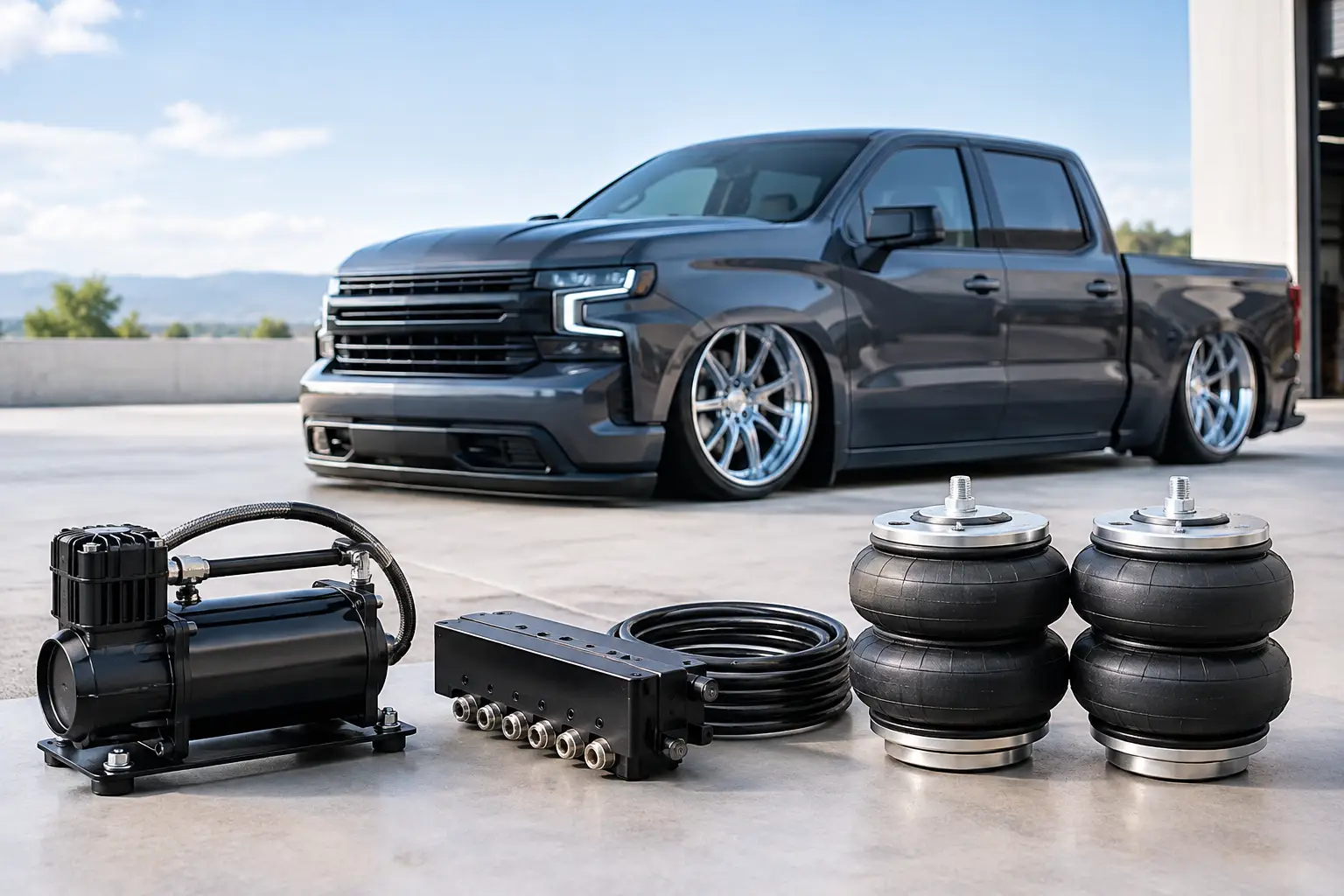
A vehicle laid out at a show gets attention. A vehicle that raises itself to clear a steep driveway, then settles into the exact ride height you built around, earns respect. That is the real answer to how does air ride work: it replaces fixed-rate suspension support with controlled air pressure, giving the driver command over height and, to a degree, ride behavior.
Air ride is not just for parking low. When properly selected and installed for your vehicle, it is a functional suspension system built around adjustable air springs, a compressor, air storage, valves, and a controller. The result is a stance that can change when the road demands it.
How Does Air Ride Work?
Traditional coil springs hold a vehicle at one static height. Air ride replaces those springs, or works alongside the factory suspension design depending on the platform, with reinforced rubber air springs commonly called air bags. Each bag fills with compressed air. More air pressure expands the bag and raises that corner of the vehicle. Releasing air lets the bag compress and lowers it.
The system moves air from an onboard tank through air lines and electronically controlled valves. A controller tells those valves when to add or release air at each corner. Press a preset on the remote, wired controller, or compatible app, and the system returns the vehicle to a saved height. At its simplest, that is the entire operation: pressure raises the chassis, exhaust lowers it.
What separates a serious setup from a basic one is control. A well-configured system can raise the vehicle to driving height, level it after loading passengers or gear, and drop it to a show-height preset when parked. This is why air ride makes sense for builds with aggressive wheel fitment, low-profile tires, deep lips, wide forged wheels, or bodywork that sits close to the pavement.
The Core Parts of an Air Ride Suspension
An air ride system works as one package. The bags get most of the attention, but every component affects response, reliability, and how clean the finished install looks.
Air springs replace the fixed support
Air springs are durable rubber bellows designed to carry vehicle weight. Their shape and mounting style vary by application. Some vehicles use sleeve-style bags, while others need double-convoluted bags or struts that combine the air spring and shock assembly into a single unit.
Vehicle-specific brackets and mounts matter here. The suspension must maintain proper geometry through its usable travel, and the bag must not rub, bind, or overextend. Universal parts can have a place in fabricated builds, but a platform-specific system is usually the cleaner path for a street-driven custom vehicle.
Compressors and tank store the pressure
The compressor creates compressed air and sends it to a tank. The tank acts as a reserve, so the system can make height changes quickly without running the compressor every time you hit a button.
Tank size and compressor count affect performance. A single compressor can work well for a modest system and occasional adjustments. Dual compressors and a properly sized tank provide faster recovery, which matters when the vehicle is adjusted frequently or when you want quick response at meets, shows, and on the street. More capacity also means more electrical demand, more heat, and more planning during installation.
Valves direct air to each corner
The valve manifold is the traffic controller. It directs air into or out of each individual air spring. Independent corner control lets the system raise, lower, and level each corner rather than treating the vehicle as one unit.
Fast valves make the vehicle react quickly, but speed is not always the goal. An overly aggressive setup can feel abrupt and make precise height adjustments harder. The best tune matches the build: a show-focused vehicle may prioritize fast movement, while a daily-driven truck or luxury sedan may benefit from smoother, more controlled adjustments.
The controller sets the height
Most modern systems use a digital controller with programmable presets. You might save a practical driving height, a higher setting for rough roads or steep entrances, and a parked height that puts the vehicle where you want it visually.
There are two common control approaches. Pressure-based systems use the amount of air pressure in each bag as the reference. They are straightforward and effective, but a given PSI does not always equal the same ride height because load, temperature, and road conditions can change bag behavior.
Height-based systems use sensors mounted at the suspension to measure the vehicle’s actual position. This offers more consistent ride-height repeatability, especially when the vehicle carries passengers, cargo, or variable loads. For a build where exact fender-to-wheel relationship matters, height sensing is often worth the added setup time.
What Happens When You Raise or Lower It?
At a driving-height preset, the controller opens the fill valves and sends stored air from the tank to the bags. As each bag expands, the chassis rises. The controller stops at the programmed target, whether that target is based on pressure or sensor height.
To lower the vehicle, the exhaust side of the valve opens and releases air from the bags into the atmosphere. The chassis settles down under its own weight. If the system has independent corner control, it can make small adjustments to keep the vehicle level rather than letting one side sit noticeably higher than the other.
This process takes seconds, not minutes. But the vehicle should never be driven at its lowest parked setting unless that height has been specifically engineered for safe suspension travel, steering movement, tire clearance, and drivetrain angles. Low looks right. Functional low takes planning.
Ride Quality: What Air Ride Changes and What It Does Not
Air ride can deliver a composed ride, but it is not magic. Ride quality depends on the full suspension package: shock or strut valving, bag selection, suspension geometry, wheel and tire choice, alignment, bushing condition, and the height at which you drive.
Air springs have a progressive nature. As they compress, their effective spring rate can increase. That can help support a vehicle through changing loads, but it also means the system needs to be set up correctly. Running a bag too low or too high for its intended operating range can create a harsh ride, poor handling, or premature wear.
Dampers do the job of controlling movement. The air bag supports the vehicle, while the shock or strut controls how quickly the suspension rebounds and compresses. A premium air ride build needs both pieces working together. Installing bags without addressing worn shocks, poor alignment, or inadequate travel will not produce the result enthusiasts expect.
Why Wheel Fitment Makes Air Ride Different
For custom wheel builds, air ride changes what is possible. It allows a vehicle to sit at a clean, intentional parked height while still having the clearance to drive. That is especially valuable when running wider wheels, lower offsets, larger diameters, or a close fender-to-tire relationship.
Still, air ride does not erase the rules of fitment. A wheel and tire package must clear the suspension, fender liners, brakes, and bodywork at driving height and through steering and suspension travel. The parked height is only one position. The real test is what happens during turns, dips, compression, and full lock.
This is where a coordinated build matters. Air ride, forged wheels, tire sizing, alignment, and fender work should be planned together instead of added one at a time. Ryder Air systems are built for enthusiasts who want that level of control without treating the suspension as an afterthought.
Air Ride Maintenance and Real-World Trade-Offs
Air ride requires more attention than a fixed coil spring setup. That does not make it fragile. It means the install needs to be clean, protected, and inspected like any serious performance upgrade.
Air lines should be routed away from heat, moving suspension parts, and sharp edges. Fittings need to be seated correctly. Electrical connections must be fused, secured, and sized for compressor demand. Moisture management also matters because compressed air creates condensation inside the system. A water trap and regular tank draining help protect valves and internal components.
There are trade-offs. Air ride adds cost, weight, wiring, plumbing, and installation complexity. Compressors make noise when replenishing tank pressure. A poorly installed system can leak, sit unevenly, or create headaches that have nothing to do with the quality of the parts.
But a properly built system gives a custom vehicle something fixed suspension cannot: the ability to adapt. It can clear obstacles, accommodate load, protect an aggressive front lip, and park at a height that makes the whole build hit harder.
The right air ride setup is not about pressing a button for the sake of it. It is about building your vehicle around the height you want to see, then keeping it capable of going wherever you actually drive it.